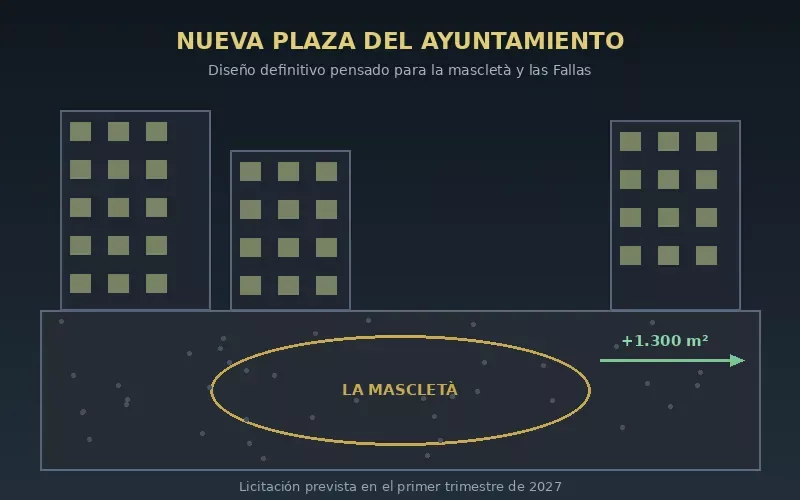
Valencia City Council has unveiled the definitive project for the new Plaza del Ayuntamiento, and it comes with one idea running through the whole design: the square is conceived from the mascletà outwards. Rather than turning the space into a simple garden, the design team worked with the uses that coexist there all year round, from firework displays to hospitality, the flower market, Fallas events and public transport.
The most visible change in Fallas terms is the addition of more than 1,300 square metres of public space south of the firework zone. That is the area that is currently most cramped, facing the old Telefónica building — now Hotel Centenari — and La Equitativa, and which has shrunk over the years due to safety measures. This new space for spectators will also have to work around the trees, so the mascletà remains visible in March.
The ellipse and the volaorets
Another novelty is the alignment of the central ellipse with the City Hall's axis of symmetry. Its paving evokes the volaorets, the classic Valencian firework, and the paving pattern is laid out from that line. The widths of Marqués de Sotelo are also adjusted so that two fallera commissions can pass at once and evacuation routes are guaranteed.
The flower market regains prominence with individual stalls, clad in artisanal ceramics and personalised with floral motifs, colours and each establishment's logo. The solution emerged from requests made by the florists themselves during the participatory process. The fountain, for its part, gains accessibility: surrounded by benches and without the planted border and slope that currently keep visitors at a distance.
The challenge of timing lies ahead. The council estimates the tender process will begin in the first quarter of 2027. The design team has expressed optimism about a construction schedule that allows the mascletaes to continue, without ruling out that in some year a one-off measure may be needed, such as firing at other points in the city.
Sources:
- Levante-EMV, 10 Nov 2026 — La plaza del Ayuntamiento: semipeatonal, con más espacio para la mascletà y una fuente más accesible (Moisés Domínguez y Claudio Moreno)